
What is an AI agent, Really?

Nowadays, everywhere you look, people are talking about AI agents.
They’re on social media, in the news, in product demos, startup pitches, and everyday conversations. Agents are creating their own social media accounts, pushing code to repositories, managing inboxes, and even starting drama online.
Some describe them as personal assistants or junior employees. Others believe they will replace entire teams. And many dismiss them as just another hype cycle.
Amid all these claims and viral threads, a simple question comes up:
What is an AI agent, really?
What an AI Agent is NOT
Before defining what an AI agent is, it helps to clarify what it is not. There are two common misconceptions:
Agents vs Chatbots: A chatbot is typically powered by a large language model (LLM). It interacts with you through conversation. You ask a question, it generates a response. Support bots on websites, help desk assistants, even advanced conversational AI tools all fall into this category.
This confusion is understandable. Most agents are built on top of LLMs.
A chatbot can:
- Answer questions
- Explain concepts
- Brainstorm ideas
- Help you plan
But it stays inside the conversation. It cannot go and perform tasks for you. An agent can.
Agents vs Workflows: Agents are often associated with automation, but automation itself is not new. We have had workflows for years.
A workflow follows predefined steps:
Input → Step A → Step B → Step C → Output
You decide the path in advance. The system executes exactly what you designed. If you know precisely what should happen and in what order, a workflow is perfect.
But that is not always the case. Agents operate differently.
You define a goal, not every step. The agent determines which tools to use, in what order, whether more information is needed, and how to adapt as context changes.
The Anatomy of an AI Agent
Now that we’ve clarified what an agent is not, what actually makes something an agent?
To understand it clearly, we can break it down into three core components:
Decision-making: This is the heart of an agent. Instead of following fixed steps, an agent continuously asks:
- What is the current state?
- What is the goal?
- What is the best next action?
It operates in a loop:
Observe → Decide → Act → Re-evaluate.
With each cycle, it updates its understanding and adjusts its path toward the goal.
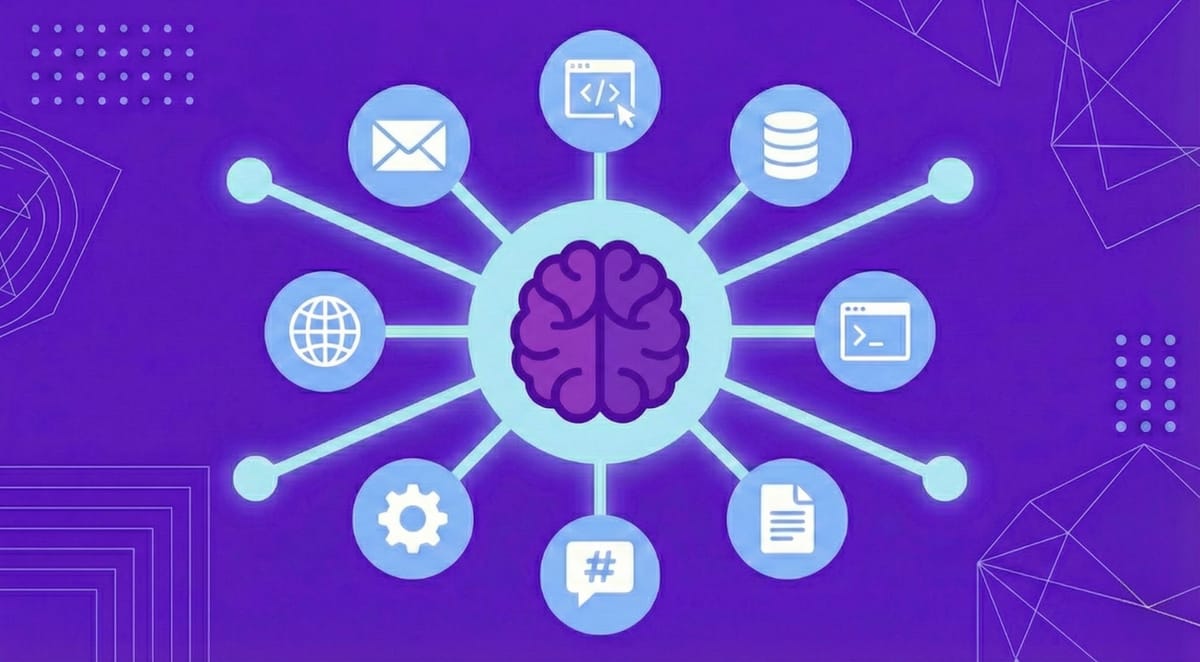
Tools: Tools are what give agents real-world impact. Without tools, you have a conversational interface. With tools, the agent can take actions in the real world through external systems.
These tools can be simple:
- Reading documents
- Querying a database
Or more complex:
- Browsing the web
- Publishing content
- Updating project boards
- Pushing code
Modern systems are increasingly standardizing this connection layer. Concepts like Model Context Protocol (MCP) servers allow agents to connect to everyday tools such as Notion, Miro, GitHub, Slack, and others.
The more tools an agent can access, the broader the range of tasks it can handle.
Memory and Context: Memory allows an agent to build context over time instead of starting from scratch at every step.
An agent can:
- Retrieve information
- Store intermediate results
- Compare new inputs with previous context
- Refine decisions as new data appears
Imagine you say:
“Look at my emails and identify the most important task. Then complete it.”
The agent might:
- Retrieve emails
- Extract potential tasks
- Check your product board for milestones
- Compare urgency and impact
- Decide which task matters most
- Realize additional context is needed
- Pull more information
- Adjust its plan
Each new piece of information influences the next decision.
That ongoing loop of gathering context, deciding, and adjusting is what makes it an agent.
To sum it up:
AI agent is a system that autonomously pursues a goal by deciding what actions to take, using tools to interact with external systems, and adapting based on new information.
Looking Ahead
So where does this leave us?
Models are improving. Tool ecosystems are becoming more standardized. As these layers mature, agents are becoming more practical in real-world settings.
You can now use agents to:
- Automate repetitive knowledge work
- Handle inbox triage
- Draft and push code
- Consolidate information from project boards, documentation, and databases
It is still early. Most systems are heavily supervised and constrained. But the opportunities are growing, and I am genuinely excited to see what the next year brings and what people build.