Specialists, Generalists, and Builders

There's an old tension in how organisations build teams: do you hire specialists who go deep, or generalists who go wide?
For most of the last century, the answer was obvious. Specialise. Industries were stable enough, problems repeated often enough, and tools changed slowly enough that depth compounded. The specialist's bet — that the thing they were getting good at would still matter in ten years — was usually a safe one.
That bet is harder to make now. Not because depth has stopped being valuable, but because the conditions that rewarded specialisation are narrower than they used to be. The work has started moving faster than the depth can keep up with.
This piece is about a simple principle, and an old one: specialists win in stable environments, generalists win in moving ones. The interesting question isn't which is better. It's which kind of environment you're actually operating in — and whether you've noticed it's changed.
Why specialisation wins when the world is stable
Specialisation is one of the most powerful ideas in the history of work. Adam Smith opened The Wealth of Nations with it. The reason it works is simple: when the same problem repeats often enough, the person who has done it a thousand times will do it better than the person who has done it ten.
Depth compounds. A specialist sees patterns invisible to a generalist. They develop unconscious competence — the kind of expertise that lets them notice something is off before they can articulate why. They make fewer mistakes, find faster solutions, and produce better outcomes than anyone working in their domain part-time.
This is real, and it doesn't go away. Surgery, structural engineering, large-scale infrastructure, regulated finance — these are specialised for good reasons. The work is stable enough, repeated enough, and unforgiving enough that depth pays off again and again.
In any environment with those properties — predictable problems, slow-changing tools, high cost of mistakes — specialists outperform generalists. Not by a little. By a lot. The conditions are doing most of the work, and specialisation is the structure that takes advantage of them.
Why generalists win when the world moves
The conditions reverse when the environment stops being stable. When the problems shift faster than depth can compound, accumulated mastery starts working against the person who built it. By the time they've gone deep on the current version of the problem, the problem has moved.
In moving environments, what matters isn't how good you are at the thing in front of you. It's how quickly you can be useful at the next thing. That's where breadth pays off.
People who can hold context across multiple domains win because most modern problems live across domains rather than inside one. People who are comfortable being a beginner win because that's the default state when the work keeps changing. People who are willing to make decisions on incomplete information win because incomplete information is what moving environments produce.
None of this is about being smarter or more talented. It's about a structural match between how someone works and what the work requires. A specialist in a moving environment isn't underperforming because they're less capable. They're underperforming because the depth they've invested in keeps getting devalued by changes outside their control.
The frustration of working in the wrong mode for the environment is real on both sides. Specialists in moving environments feel like the ground keeps shifting. Generalists in stable environments feel underused. Neither is doing the wrong job. They're in the wrong conditions for the operating style they're built for.
The world is moving faster, and AI is the accelerant
The tension isn't new. What's new is how quickly the balance has been tilting.
Every wave of better tooling over the last forty years has narrowed the conditions where specialisation pays off. The compiler reduced the value of assembly-language depth. The web framework reduced the value of low-level HTTP and DOM expertise. The cloud reduced the value of hands-on infrastructure mastery. Each wave, the layer that was the specialist's territory got absorbed into a tool, and the specialism became less of a moat.
AI is the most aggressive version of this we've seen. Tools like Claude can produce a competent first pass at most well-scoped problems in minutes. The implementation layer — the part most engineering specialisations were built around — is being commoditised in real time.
What rises in value when execution gets cheap is everything execution isn't: knowing what's worth doing, understanding the problem deeply enough to frame it correctly, holding the context across the whole system, judging when something is good enough, recognising when the answer the tool gave you is subtly wrong.
These aren't depth skills. They're the kind of skills that come from having held many different kinds of problems and learned to move between them. The trend isn't AI-specific. AI is just the strongest current example of a pattern that's been running for decades.
The new shape isn't "generalist" — it's "builder"
Here's where the binary breaks down. The framing of "specialist vs generalist" has carried us this far, but it isn't quite right for where the work is heading.
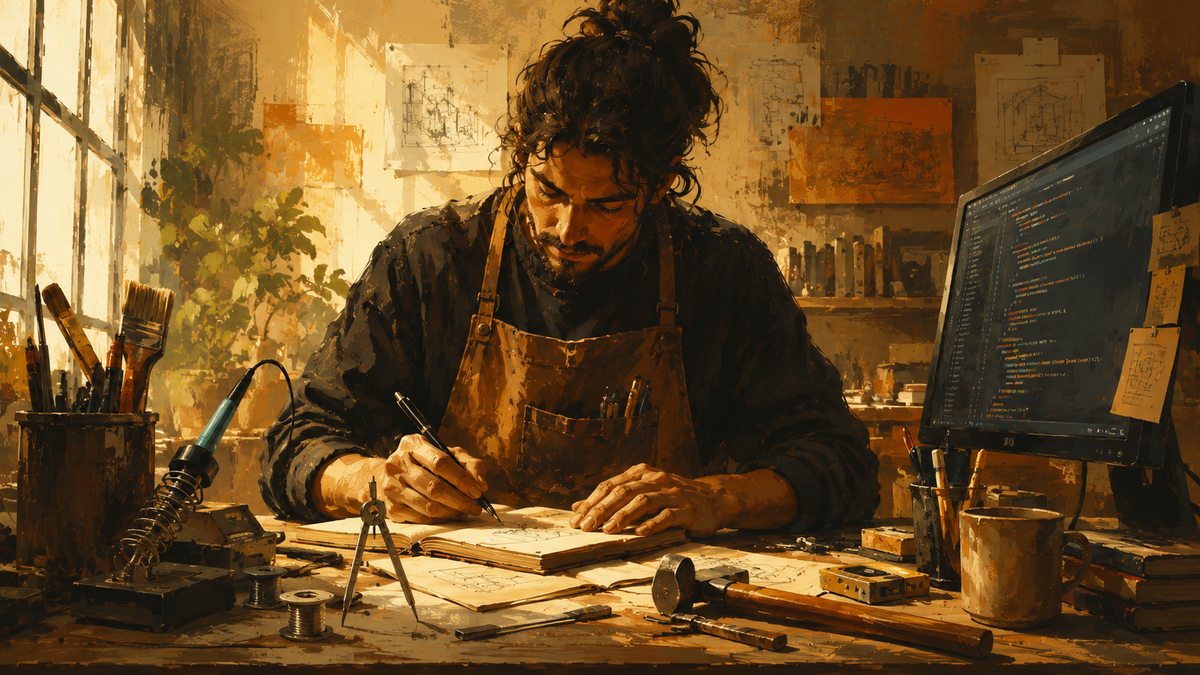
The most valuable people on a modern team aren't generalists in the classic sense — someone who knows a bit about everything and is great at none of it. They're builders. People with a real centre of gravity in some craft, who got loose enough to operate outside it.
A great builder has a starting point. One came up as a designer and learned to ship code. Another came up as a security engineer and learned to think about product. Another came up full-stack and learned to do real research. They all converged on the same place — they ship things end-to-end, hold the whole picture, and use whatever tools, including AI, to compress the parts that aren't where their judgement lives.
What makes them valuable isn't generality. It's that they each carry the texture of where they came from. The designer-builder thinks about UX in a way the full-stack-builder never will. The security-engineer-builder spots failure modes the designer-builder would miss. They're not interchangeable. They're complementary.
The team that wins from here isn't a team of generalists. It's a small squad of builders who came from different places and learned to meet in the middle. Specialists who got loose. Generalists with a craft. Whatever you want to call it — they're not the old binary, and they're not what most companies are still hiring for.
How this shapes our team
This is the principle behind how we build our engineering team at Opply. The work in front of us isn't stable — problems change weekly, they cross boundaries, and the tools keep shifting underneath us.
We're not trying to hire generalists in the abstract sense. We're trying to hire builders with a real centre of gravity, who came from somewhere specific and can move outside it. That's also why we hire product engineers rather than software engineers — the role is a particular expression of this shape, but the underlying reasoning is what this piece has been about.
The honest question
The honest question isn't whether to hire specialists or generalists. That binary is already breaking down. The question is whether the people on your team are builders — and whether you've given them the conditions to be one.
The conditions that rewarded narrow specialisation are narrowing themselves. What's rising in value isn't generality. It's the ability to carry a craft into unfamiliar territory and still ship something good.